

Today, when you sell products on Amazon, success is based on the quality of the item and the visibility of the product data. There is a lot of competition in every category, so the most important part is optimizing your product data.
Amazon uses a proprietary, complex search algorithm that relies on structured, accurate, and relevant product data to evaluate which products will show up in searches, so it is important that Amazon Product Data Enhancement is used as a basis for ranking, traffic, and converting sales.
When you enhance the product data correctly, you make it easier for Amazon to find an accurate description of your product and assist customers with making a purchase decision. Sellers achieve product data enhancement by either creating or using a third-party provider with Amazon product listing services to support their long-lasting success while maintaining a competitive advantage over other sellers.
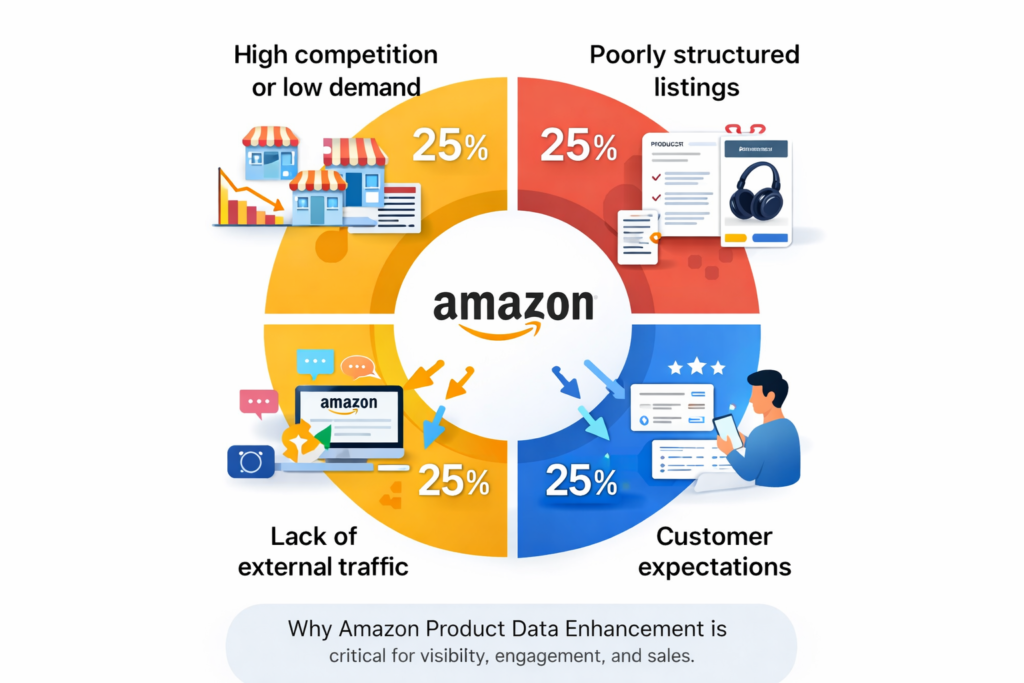
The Lack of Amazon Product Data Enhancement
When considering how to enhance the performance of your products on Amazon, it’s important to consider what will happen if your current product data is not optimized correctly. Many sellers find that their account performance is not due to the product itself; instead, the seller’s product data does not accurately represent or describe the product, and thus, it is not being promoted to potential buyers correctly.
- High competition or low demand: Some products will not find a market because they are too near the end of their production or because there is not enough demand for them. It is essential to perform adequate research on your product before listing it in order to ensure that there is a viable market for it.
- Poorly structured listings: Unhelpful words in the title (keyword use), vague bullet points, unsatisfactory product descriptions, & low resolution pictures will hinder people from finding your listing and will not give them the confidence to buy from you. Each part of your product listing will add to your customer’s ability to discover your product and build trust in you as a seller.
- Lack of external traffic: Visitor traffic via blog posts, social media, and other sites can increase your visibility and improve your rank. Relying only on organic traffic from Amazon does not represent a complete audience.
- Customer expectations: Research shows that many buyers look for a good amount of detail about a product before making a purchase decision. Therefore, a product that has an incomplete or unclear listing will usually receive lower conversion rates, more negative product reviews, and less long-term customer loyalty.
This highlights why Amazon Product Data Enhancement is essential for ensuring visibility, engagement, and long-term success on the platform.
Why Product Data Enhancement Should Never Be Ignored
Incomplete or poor-quality product data, when listing items for sale, will typically result in low-performing products. High-quality products may still fail to sell if customers (a) don’t understand the value of your product or (b) have difficulty finding it on Amazon because it is improperly indexed.
Sellers with poorly optimized product data will suffer from poor visibility, engagement, conversions, and increased returns because there isn’t enough information on the product page to help customers. If a product does not appear as expected or is difficult to locate or lacks a professional image, customers may be confused about what they are buying, and they will likely leave negative feedback and lose trust in the seller. Over time, all of these issues will negatively impact the seller’s brand and future sales.
Therefore, treat Amazon Product Data Enhancement as a long-term strategy rather than attempting to get it done just once.
- Encourage customer reviews strategically to build trust and social proof.
- Analyze competitor listings to find gaps and new opportunities for optimization.
How Amazon Uses Product Data to Rank Listings
Amazon utilizes a search engine to evaluate information about products to help determine how valuable or relevant a given item is to buyers. This evaluation occurs with each of the various pieces of product detail provided by sellers, including the title, bullet points, description, attributes, and backend keywords, all working together to establish what the item is and who it’s ideally suited for.
When you structure your data well, it will also help align your listings with buyers’ search intent, which has the added benefit of improving discoverability. Well-structured product data will also improve the overall shopping experience for your customers by providing accurate and complete information about an item.
Sellers that are willing to put time and money into developing high-quality product data (usually done by utilizing Amazon Product Listing Services) will tend to have better organic rankings and can expect this to continue for years to come.
- Optimize for voice search to capture traffic from Alexa and smart devices.
- Structure content for mobile-first shoppers, who make up a large portion of Amazon traffic.
Conducting Proper Research Before Optimization
Understanding Market Demand
Prior to enhancing product data, it is essential to verify that there is enough demand for the product. Performing market research allows a seller to identify the needs of customers, the expected price range and the current competitor landscape. If there is no demand for your product, then optimizing your listing will do little for the effectiveness of your well-written content.
- Focus on seasonal or trending products to maximize listing impact.
Keyword Research as the Foundation
Keyword investigation is important in improving Amazon product data. Keyword research tells you the terms that customers are really using to search for products and, thus, will influence how you create titles, product descriptions, and back-end keywords to increase your product’s relevancy without crowding with keywords.
- Include long-tail and question-based keywords to capture niche searches effectively.
Creating High-Impact Product Titles
Balancing SEO and Readability
Amazon uses product title/description as its key ranking factor. The title should contain a clear description of the product and its important keywords. When excessively adding keywords to titles, this can create difficulty in reading and decrease the conversion rate. To create a successful title, the name of the product, the primary feature, and very important attribute(s) like size, material, and compatibility should be included. By ensuring the title is clear and compliant, you will achieve better indexing and enhance the click-throughs of your item listings.
- Test multiple title variations to determine which drives higher CTR.
- Highlight unique selling points to stand out in competitive categories.
Writing Bullet Points That Convert
Focus on Value, Not Just Features
A list of technical specifications should not simply be a list of technical specifications; it should highlight how the product will benefit the customer. Each bullet point should answer some of the questions that may arise in the customer’s mind, thus removing the potential for doubt that could prevent them from completing a purchase.
When written in this manner, the bullet points will provide clarity and increase trust and support for relevant keywords. For these reasons, Amazon Service Providers focus on optimizing benefit-driven bullet points for product listings.
- Include use-case examples to make bullets more relatable.
- Mention warranties or guarantees to build buyer confidence.
Developing Detailed and Engaging Product Descriptions
Turning Information Into Persuasion
Product descriptions allow sellers to provide complete stories about the products they sell. A good product description should include details about the features of the product, including actual examples of how the product is used, as well as evidence of quality.
A well-written product description will help the customer see how the product meets his/her needs.
Using short paragraphs for product descriptions instead of long paragraphs with a lot of text increases readability and helps the customer stay interested in the product. A good product description helps to enhance Amazon Product Data Enhancement by increasing relevance and increasing the number of conversions.
- Add storytelling or scenario-based examples to enhance customer connection.
- Include FAQ-style answers to address common questions proactively.
Optimizing Product Attributes for Better Visibility
Attributes of products are used by Amazon to help find the correct listing categories as well as filtered search results amazon cloudfront. When attributes are not accurate or missing, this will greatly hinder the ability to see the product listed.
Attributes that are consistent with size, colour, material, and usage will improve search visibility and overall customer satisfaction when compared to products that do not have these attributes or consistent values. Accurate attributes will limit the likelihood of returns due to expectations being mismatched.
- Add custom attributes where relevant to improve filtering and search performance.
Enhancing Listings With High-Quality Visual Content
Why Images Matter More Than Ever
Photographs are usually one of the first things noticed by consumers. Quality photos give a quick and clear representation of the item being sold, which increases customer confidence in their purchase. When buyers see a clear photograph, they reduce their level of uncertainty, which increases sales.
A good image set will typically have several images: a clear main image, supportive angles, lifestyle images, and pictures illustrating product features. Visual optimization is important to the success of Amazon Product Data Improvements as well.
- Include 360-degree or interactive images for detailed product views.
- Use lifestyle images to show real-world application and boost relatability.
Using Backend Keywords Strategically
With backend keywords, sellers can add extra search terms without changing what customers see. This section must be used judiciously because your primary aim is to enhance discoverability but remain in compliance with Amazon’s policies.
Use relevant synonyms and variations of keywords to help generate more search traffic. Do not repeat a word or have irrelevant words to generate clean indexing.
- Regularly update backend keywords based on search trends and performance.
Maintaining Consistency Across Listings
For businesses that offer a range of different products within their company leadership style and structure, consistency in voice/style across the entire range of products will build credibility with buyers. A buyer can easily identify with your products through the use of similar branding/messaging/formatting, which in turn enhances your overall brand identity.
When expanding, many developers utilize the services of Amazon product listing companies as a means of developing a consistent approach across their entire catalogue, while maintaining cost-effectiveness in supporting their growth.
- Use style guides and templates to keep messaging consistent across listings.
Monitoring Performance and Updating Regularly
Optimization Is an Ongoing Process
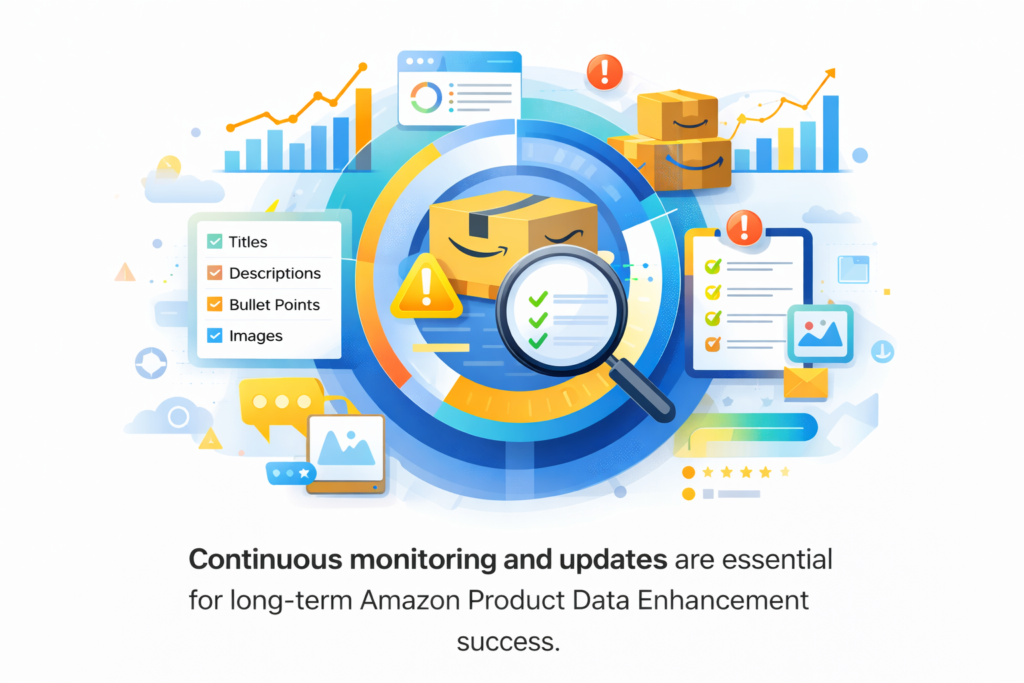
The fluctuations of competition and Amazon product-related trends, as well as consumers’ purchasing habits, are constantly changing; therefore, you need to keep track of your listing performance in order to see if it can be improved on from what was working previously.
Your listings should be updated often due to ongoing changes in search trends, customer wants/needs, as well as the listing performance (to ensure that your listings remain competitive and relevant). Continuous improvement is essential for long-term success with Amazon Product Data Enhancement.
- To efficiently track key metrics, set up automated reporting and alerts.
- To make sure that your titles, product descriptions, bullet points, and images are always accurate and optimized, you should conduct regular audits of your listings.
Conclusion
Within a market space where competition exists between sellers, Amazon) has made it so that its marketplace requires high-quality product data. Amazon Product Data Enhancements helps create a better chance that your listings would be clearly seen, informative, and enticing; thus, helping Amazon’s algorithm as well as buyers see the value of your product.
Researching and providing structured content, compelling images, and keeping your products updated (or partnering with a reliable product listing service) are ways that may help improve seller rankings, increase conversions, and provide seller sustainable growth.
TAGS
