

Images play a crucial role in attracting customers and creating an image of professionalism in branding. Be it an eCommerce business, a website for business, or using social media platforms for sharing content, the use of good quality images can bring in your potential customers. However, any unwanted objects, improper lighting, and an incorrect environment could ruin your perfectly taken photograph. And here comes the role of editing the photo background.
By editing a photo background, one can delete unwanted elements of the image, change the existing background, color-correct photos, and make many other adjustments. It will allow you to emphasize the main subject of a photograph by removing all extra distractions.
Professional companies or individuals often use photo editing services to prepare photos for various commercial purposes, such as websites, catalogues, advertisements, and social media campaigns. Photos could become cleaner, more appealing, and correspond to the visual brand’s image.
In this article, we will consider all the advantages of background editing of photos, techniques used by professionals and how to make it natural-looking for different kinds of photos.
What Is Editing a Photo Background?
Editing a photo background is the modification of the backdrop that appears in a picture, in relation to the primary figure. Editing can be achieved by removing the existing backdrop, coloring it differently, inserting a new backdrop, and fixing any unwanted element in the backdrop.
For instance, an online retailer could capture the image of a handbag using a backdrop with too many elements. Using editing of photo background technique, the retailer can modify the background to make it look clean and white.
The technique is helpful in the editing of any kind of image, whether simple or complex. While a simple image needs only to be edited in terms of background removal, a complex image will need to undergo several processes such as masking, shadowing, and coloring.
The aim is to produce an appealing image, without compromising the appearance of the object.
Why Is Photo Background Editing Important?
The background plays a key role in the perception of an image by the audience. When the background is not appealing and is not organized, viewers will pay attention to that part rather than the actual subject.
Creates a Professional Appearance
Clean backgrounds help to organize the photographs and give them an aesthetic appearance. This will help to make the images look more presentable when used in website design and brochures.
A business could also achieve a uniform appearance of its marketing photos by using similar backgrounds in all the pictures.
Improves Product Presentation
Photographs help online buyers visualize the size, shape, color, and features of a product. Distractions present in the background make it difficult to spot such information.
Product photo editing services play an important role in showcasing the essential features of a product in addition to improving viewer experience. This service is highly relevant for clothing, jewelry, electronics, cosmetics, furniture, and household items.
Supports Brand Consistency
Product images received from various vendors or photographers are likely to contain different lighting effects and different backgrounds.
By editing of photo background, companies can ensure that there is consistency in the look of their products. This would make their websites look more professional and help create brand identity.
Common Techniques Used in Photo Background Editing
Different photographs require different editing methods. The right approach depends on the subject, the original image quality, and the intended use of the final photograph.
1. Background Removal
Background elimination is an effect where the subject is separated from the rest of the image. This is done so that the background may be edited out or covered with a uniform color, a photograph, or any transparency.
It is widely used in pictures of products, portraits, fashion photography, and advertisements.
Care should be taken during the process since very small elements like hair, animal fur, clear glass, and jewelry should be considered carefully.
2. White Background Editing
White Background Editing is a commonly practiced form of editing for eCommerce because it produces a simplistic image of the product. It allows customers to pay attention only to the product itself without noticing other elements around it.
Many eCommerce platforms require using white backgrounds for product catalogs and marketplaces. Nevertheless, companies need to take into consideration individual requirements of each platform prior to posting their images.
Professional editors keep relevant shadows and reflections to ensure that the product does not seem like it is floating against a background.
3. Background Replacement
Background replacement makes it possible for editors to eliminate the existing background and set the subject in a new one.
For instance, a fashion house may opt to use an outdoor background in place of an existing indoor background. An organization may also use background in a studio while taking pictures of its employees.
Editing of photo background of photos should involve keen consideration of light, perspective, temperature and shadow among other things.
4. Background Color Correction
In some cases, the photo may have a good background but still needs some small changes. The color correction is done to adjust the lighting and balance the image.
This process can be used when the background of the photo is dark, too bright, or does not match with the subject.
5. Unwanted Object Removal
Objects that spoil images by making them appear messy include cables, garbage, decorations that do not need to be there, and even objects in the surroundings.
Techniques used to remove objects involve the cleanup of these objects while maintaining their backgrounds intact. The editors ensure that these corrections are integrated seamlessly into the photograph.
Key Benefits of Editing of Photo Background

Professional background editing offers several advantages for businesses, photographers, and individuals.
- Better image quality: Removes distracting elements and improves the overall appearance of photographs.
- Clearer product presentation: Helps customers focus on important product details.
- Consistent visual style: Creates a uniform look across websites, catalogs, and marketing materials.
- Creative flexibility: Allows the same subject to appear against different backgrounds.
- Improved marketing content: Makes images more suitable for advertisements, banners, and social media posts.
- Efficient image preparation: Helps businesses process large collections of photographs using an organized workflow.
- Professional brand presentation: Supports a cleaner and more consistent visual identity.
Although these benefits can improve an image, businesses should maintain accurate product colors, shapes, and features. Editing should enhance presentation rather than mislead customers.
How Professional Photo Editing Services Improve Images
Professional photo editing services focus on both visual quality and technical accuracy. The goal is to create polished images that look natural and meet the requirements of the intended platform.
Accurate Selection and Masking
This is achieved through selection tools, clipping paths, masks, and other methods by the editors.
The more complicated the subject, the more manual work is needed for refinement. Special care needs to be taken on fine hair, cloth borders, translucent objects, and reflective surfaces.
Lighting and Shadow Adjustment
Lighting differences can make a background replacement look artificial. For example, a brightly lit product may look out of place against a dark background with different lighting.
Professional editors balance brightness, contrast, and shadow placement to make the subject appear consistent with its surroundings.
Color Matching and Image Enhancement
Background and subject must go well together. Distinction in terms of color temperature or saturation can make the edited image look artificial.
Methods of image enhancement assist in maintaining visual harmony while retaining the original look of the object. This is of particular importance in the case of commercial photography.
Final Quality Checking
The professional should be sure to check for rough edges, halos, marks, and artificial shadows before the image is passed on.
The professional should also be certain that the final file has the appropriate dimensions, resolution, and format.
Such checks will ensure that photographs are ready for web use.
Common Uses of Photo Background Editing
The process of adapting editing techniques to suit the needs of various industries has begun.
- eCommerce product photography: Creates clean images for online stores and marketplace listings.
- Fashion photography: Improves the presentation of clothing, footwear, and accessories.
- Portrait photography: Replaces distracting surroundings with studio-style or outdoor backgrounds.
- Real estate photography: Removes minor distractions and improves property image presentation.
- Jewelry photography: The process of using editing techniques in the jewelry industry involves enhancing the background while still preserving details.
- Food photography: Creates a cleaner setting that helps dishes stand out.
- Corporate photography: Maintains consistent backgrounds for professional portraits and business profiles.
- Digital advertising: Prepares photographs for promotional campaigns, website banners, and social media content.
Choosing the right editing method depends on the subject, audience, and purpose of the photograph.
DIY Editing vs. Professional Photo Editing Services
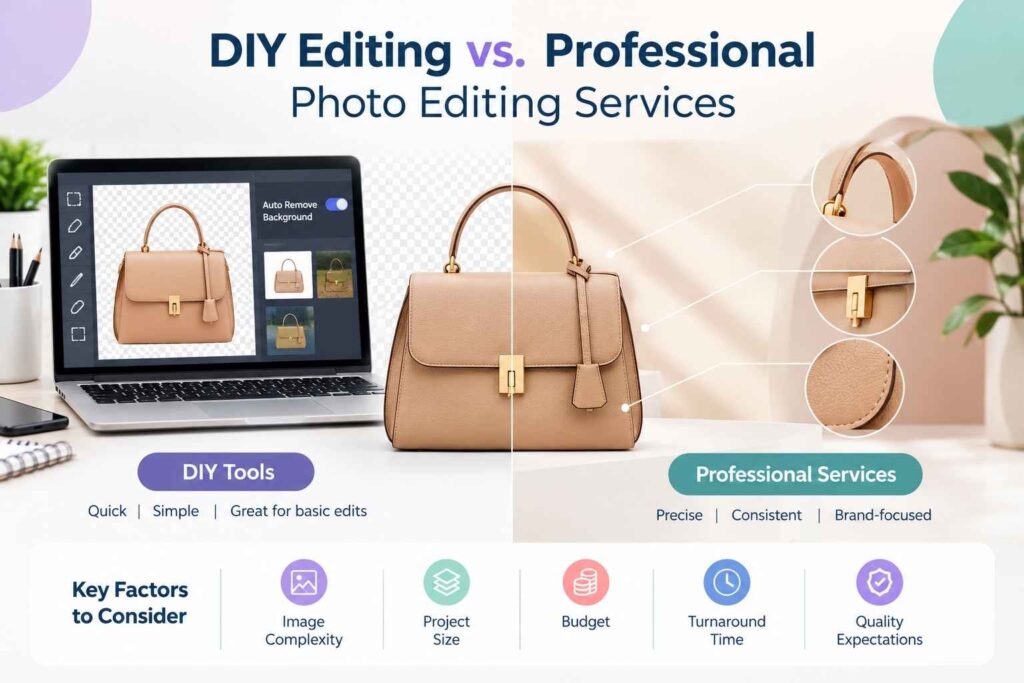
There are numerous online applications that provide automatic background removal and replacement. These applications are useful for simple pictures, personal projects, and quick social media graphics.
However, some complicated edges, transparent materials, shiny surfaces, and colors that closely resemble the background may prevent automated tools from functioning properly. Such situations require manual correction in order for the editing to look perfectly finished.
Professional photo editing companies can be useful for companies that need consistent results with their large number of photographs. Their teams of editors usually have enough experience to cope with edge detailing, shadow corrections, color matching, and the specificity of the brands they are working with can refine edges, correct shadows, match colors, and follow specific brand guidelines.
Before choosing between DIY tools and professional services, consider the following factors:
- Image complexity: Detailed subjects may require advanced editing techniques.
- Project size: Large image collections may benefit from an organized professional workflow.
- Budget: Simple images may be manageable with free tools, while complex projects may require paid services.
- Turnaround time: Businesses with strict deadlines may benefit from outsourcing image editing.
- Quality expectations: Commercial projects often require detailed quality checks and consistent results.
The best approach depends on your budget, project requirements, and expected image quality.
Tips for Natural-Looking Background Editing
A successful edit should improve the photograph without making it look artificial. Small details can make a significant difference in the final result.
Follow these practical tips:
- Choose the right background: Select a setting that complements the subject and suits the image’s purpose.
- Preserve fine details: Carefully refine hair, fur, fabric, and transparent objects.
- Match lighting conditions: Ensure that the subject and background appear naturally connected.
- Maintain realistic shadows: Use appropriate shadows to create depth and dimension.
- Keep colors accurate: Avoid changes that misrepresent the actual appearance of a product.
- Use suitable image dimensions: Export photographs according to the requirements of the target platform.
- Inspect the final result: Review images at full size to identify rough edges and editing marks.
Following these practices helps create attractive images while maintaining a realistic appearance.
How to Choose the Right Photo Editing Service Provider
Choosing a trustworthy service is beneficial for companies as they will enjoy quality images, which have been treated in an effective manner.
Begin with checking out the provider’s portfolio. Look for instances of background removal, masking, clipping, etc.
Inquire about time, pricing, revisions, and how images will be delivered as well. In case you need a large number of photos to be completed, find out what measures the service takes to produce consistent results.
Consider these points when selecting a provider:
- Review previous work to evaluate editing quality.
- Confirm experience with complex subjects and detailed edges.
- Explain your preferred background style and image dimensions.
- Ask about quality checks and revision procedures.
- Check whether the final files meet your website or marketplace requirements.
Clear instructions and regular communication help reduce revisions and improve the final results.
Conclusion
Making use of editing techniques in the process of changing a picture background can significantly enhance the appeal of the image in question. The process of eliminating distracting elements from photographs, altering unwanted backgrounds, working with colors and producing proper shadows are the methods which help businesses improve their presentation of goods and services.
Techniques mentioned above are significant for online shops, photography studios, advertising agencies and other companies that require high-quality visuals.
There is a better result when choosing the right background, keeping all necessary details, and making sure that the background does not look unnatural. Professional photo editing service is very helpful for companies that have lots of images to edit and keep the same quality of pictures.
TAGS
