

Images have proved to be one of the most powerful tools of communication in the digital world today. Whether you’re sharing content on social media, building an online brand, marketing products, or recording personal memories, the quality of your images can greatly affect how people view them.
A professionally enhanced image is eye-catching, builds credibility, and helps messages get across better. Even if you use a top-of-the-line smartphone camera or professional photography equipment, raw photos are not perfect. Lighting issues, skin imperfections, distracting backgrounds, color imbalances, and small imperfections can all diminish an image’s overall quality. That is why photo editing has become an essential part of modern photography workflows.
The rise of face editor tools and AI photo retouching technology has completely transformed the editing process. What once required extensive software knowledge and hours of manual work can now be achieved through intelligent automation. These tools allow photographers, businesses, influencers, and everyday users to retouch pics quickly while maintaining a natural appearance. As artificial intelligence continues to evolve, image enhancement is becoming faster, smarter, and more accessible than ever before.
What Is a Face Editor?
A face editor is a photo editing solution designed to improve portraits and facial photographs. Modern face editors use artificial intelligence to recognize facial features and automatically apply improvements, unlike traditional editing methods, where users have to manually adjust every detail.
These tools study the skin texture, eyes, lips, teeth, facial contours, and lighting conditions before making corrections. The goal is to enhance the image quality while retaining the natural appearance of the subject. Whether you’re editing a professional headshot, wedding portrait, or casual selfie, a face editor can help you get polished results with little effort.
How Face Editors Work
Modern face editors are driven by artificial intelligence and machine learning algorithms that understand facial structures. Upon uploading an image, the software detects important facial landmarks and analyzes areas that could be improved. This enables the tool to make precise adjustments without the need for you to manually enter each detail.
The editor can automatically remove blemishes, improve skin tone, lighten eyes, and portrait lighting. The adjustments are based on AI-powered analysis, so the results tend to be more natural and consistent than heavily edited images from traditional methods.
Features Found in Modern Face Editors
Today, Face editors come with a wide variety of features to make portrait enhancement easier. With these tools, users can enhance the quality of images without spending hours learning complex software.
The popular features include skin smoothing, blemish removal, eye enhancement, teeth whitening, portrait sharpening, facial balancing, background cleanup, and color correction. Batch editing features are common among many AI tools and are especially useful for photographers looking to quickly process large volumes of images.
Benefits of Using a Face Editor
One of the biggest advantages of using a face editor is speed. The jobs that used to take a lot of manual work can now be done in minutes. This allows photographers and businesses to accomplish more, all while still producing professional-quality results.
Availability is another plus. Face editors provide advanced retouching techniques to all levels of users. Even amateurs can produce professional-looking portraits with little training and no technical skills.
Understanding AI Photo Retouching
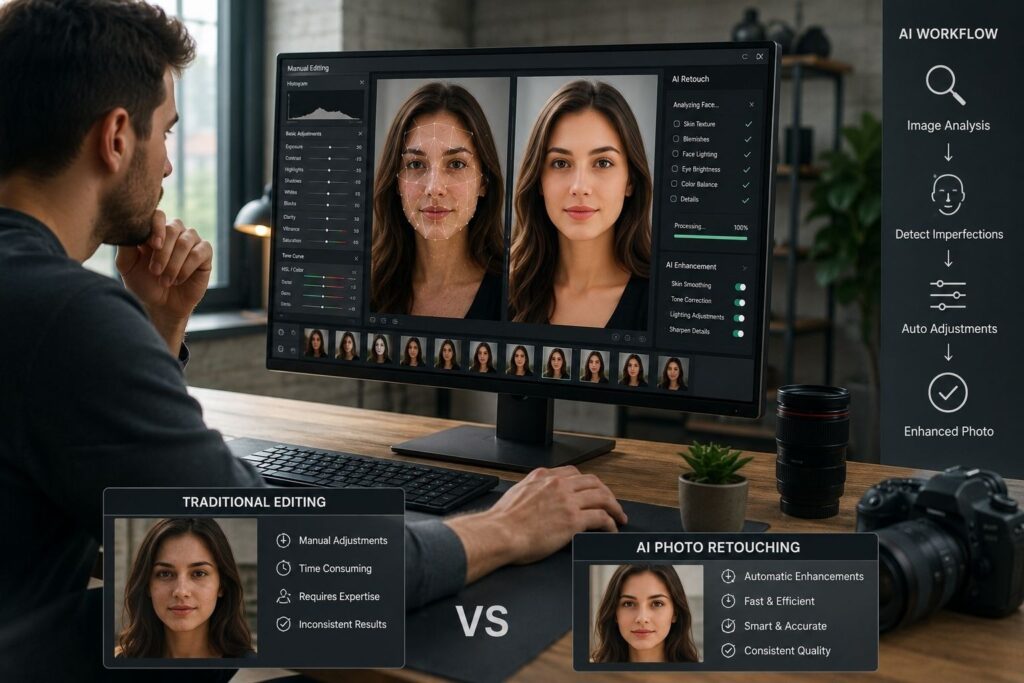
Artificial Intelligence (AI) Photo Retouching uses artificial intelligence to automatically assess and correct the quality of a photo. Rather than having to do everything manually, the computer uses intelligence to check the photo and make on its own improvements to the photo based on things it has learnt about from other photos that have been edited by professionals.
AI Photo Retouching has become a popular choice due to its combination of efficiency, accuracy, and consistency with photo quality from photo editors. Automating repetitive photo editing tasks enables the same user to create high-quality photos much more quickly.
What Makes AI Different From Traditional Editing?
While regular photo editing allows for total control over adjustments by an editor, it can require a considerable amount of expertise and time if the user wants to use all the tools available to them, as well as correcting exposure, contrast, color balance, and skin imperfections manually to create the final image they want.
AI photo retouching is an automated method that uses Artificial Intelligence to assist in making automatic intelligent decisions based on analyzing images for areas that need correction and apply corrections to those areas with very little intervention from the user, which decreases the amount of time needed for editing photos and maintains a consistent amount of quality of photos.
Why AI Retouching Is Growing Rapidly
Visual content is increasingly in demand across all types of businesses. Professional marketers want to produce high-quality images, and photographers want to create an efficient workflow. Social media creators need to produce images that are visually appealing for their followers.
AI technology for image retouching will help businesses meet these rapidly growing demands by streamlining the editing process and decreasing turnaround time. As technology becomes more advanced, a larger number of individuals and organizations are embracing AI technology to enhance their images.
Why People Retouch Pics
People will retouch photos for a variety of reasons; they may want to just make their personal photos better to put them up online, or businesses also often make changes to their photos so they can promote themselves and their brand better, but no matter what the reason for retouching a photo, it will give the photo a more complete look and a more professional feel.
With images serving as a representation of someone in today’s digital world, an edited photo can help improve engagement, trust, and communicate a level of professionalism that cannot be achieved with a non-edited photo. Even small edits can greatly improve the impression of a photo overall.
Social Media Content
Visual content is extremely important in Social Media platforms; therefore, having good-quality images is essential for engagement with those communities. Users edit their images for various reasons, including fixing lighting, removing distracting elements, and establishing similar aesthetics throughout their social media profiles.
Professional Photography
Wedding, fashion, family portrait, and corporate headshot photography all benefit from the use of professional retouching techniques. Professional photographers use these techniques to create high-quality, polished images for their clients. Professional retouching techniques can provide subtle improvements to overall aesthetic appeal without compromising image authenticity or quality.
Business Marketing Images
Retouching is an important part of professional photography, giving clients the best possible images. Many types of photographs, including wedding, fashion, family portrait, and corporate headshot, can be improved via retouching, making for higher quality images without losing the authentic nature of the photograph.
Touching Up Pictures Without Overediting
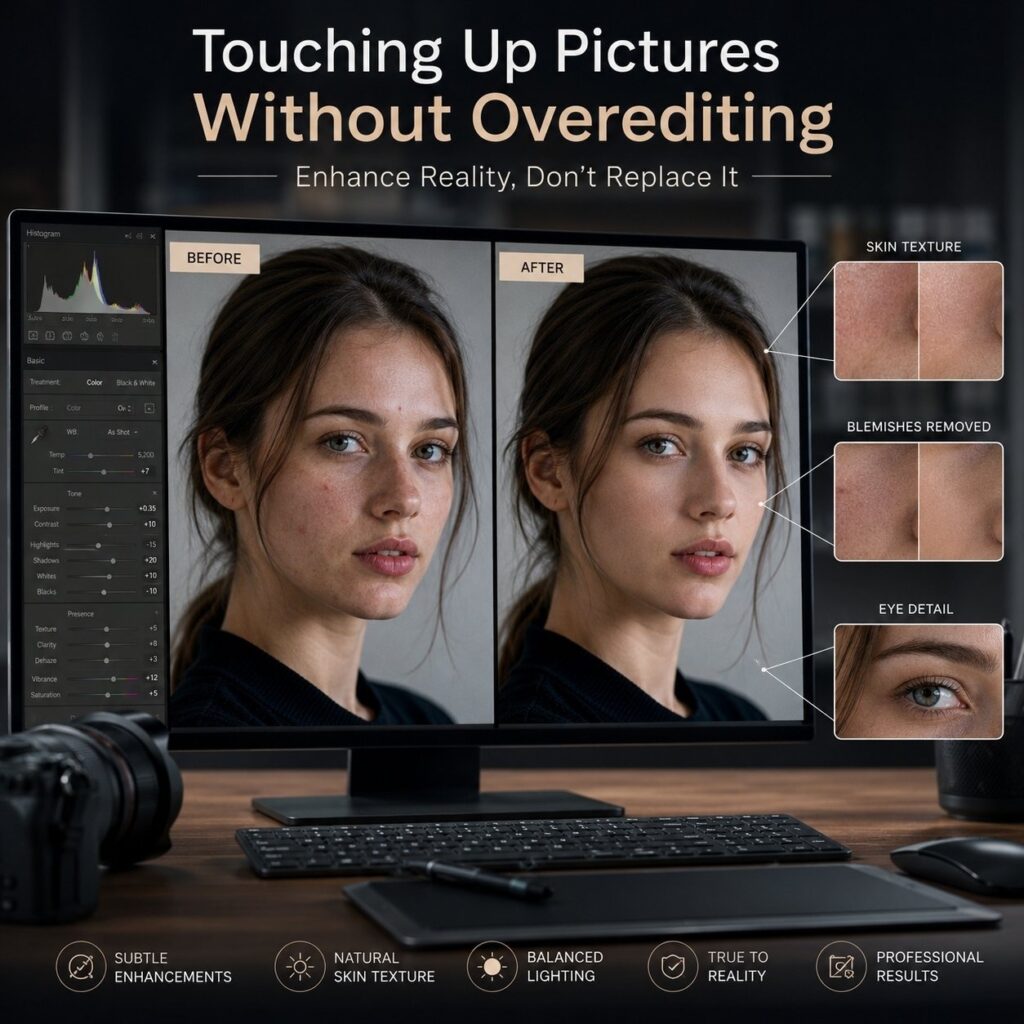
Excessive editing of an image may yield results that do not look realistic, yet fixing an image can greatly enhance it. Instead of changing the attributes of a person or item, the goal of image retouching should be to enhance each item by removing disruptive distractions (to the viewer) or by improving the visual appeal of an item, whilst still being able to see the characteristics of the person or item. Generally, using more subtle forms of enhancement yields a more professional-looking and believable photograph.
Preserve Natural Skin Texture
Skin texture is an important part of realistic portrait photography. Removing every pore and line may create a smooth appearance, but it often makes the image look artificial. Maintaining natural texture helps preserve authenticity.
Maintain Realistic Facial Features
Small adjustments can improve facial balance and symmetry, but dramatic reshaping can make portraits appear unnatural. The best edits enhance existing features rather than replacing them.
Focus on Overall Image Quality
Retouching should improve the entire photograph rather than concentrating on a single element. Balanced lighting, accurate colors, and clean compositions contribute significantly to professional-looking results.
Best Photos to Touch Up
Not every photograph requires extensive editing, but certain image categories benefit greatly from professional enhancement.
Portrait Photography
Portraits are among the most commonly retouched images because facial features naturally attract viewer attention. Improving lighting, skin tone, and sharpness can dramatically enhance portrait quality.
Professional Headshots
Headshots are often used for business profiles, websites, and networking platforms. A polished headshot helps create a positive first impression and reinforces professionalism.
Wedding Photography
Wedding photographs capture meaningful moments and deserve careful enhancement. Retouching helps improve lighting, remove distractions, and ensure consistent quality throughout the collection.
Product Photography
Product images influence purchasing decisions. Professional editing helps products appear cleaner, sharper, and more appealing to potential customers.
Common Photo Retouching Mistakes
Over-Smoothing Skin
One of the most common retouching mistakes is removing too much skin texture. While smooth skin can make a portrait look polished, excessive smoothing often creates a plastic-like appearance. Preserving natural details helps maintain realism and authenticity.
Excessive Face Reshaping
Many users attempt to dramatically alter facial features to create a more attractive appearance. However, extreme reshaping can make portraits look unrealistic and unrecognizable. Subtle adjustments generally produce more professional results.
Over-Whitening Teeth
Brightening teeth can improve a smile, but excessive whitening often appears unnatural. Maintaining realistic color levels helps create a healthier and more believable appearance.
Ignoring Background Distractions
A beautifully retouched portrait can still be weakened by cluttered or distracting backgrounds. Removing unwanted objects and distractions helps keep attention focused on the subject.
Using Too Many Filters
Applying multiple filters and effects can make an image appear heavily edited. Professional retouching relies on subtle enhancements that improve the photograph without making the editing obvious.
The Future of AI Photo Retouching
Ongoing changes made by artificial intelligence in the photography industry are being introduced through AI products that can improve portrait enhancement, provide instant editing options (live edits), create a custom filter, and allow users to remove objects from the photo with better technologies.
The increasing sophistication of machine learning algorithms being developed around this technology will allow users to have access to even more powerful solutions for editing their photos. These new solutions will enable faster, more accurate, and more available means for professional-quality photo enhancement for photographers, businesses, and content creators.
Conclusion
Photo retouching and face editor tool technologies have changed how photographs are changed by enhancing or optimizing them. From social media and professional images to product photography and marketing material for a business, the tools allow for the fast and consistent creation of high-quality images.
The most effective way to retouch an image is to balance it. Successful edits enhance the strengths of an image, instead of dramatically changing the image. Understanding the way in which AI-powered tools work and adhering to the best practices are important for photographers, businesses, and casual users to produce visually compelling photographs that create a lasting impression.
With advancing technology, the power of AI image enhancement will continue to increase, enabling users to create images of professional quality with less effort and increased creative flexibility.
Frequently Asked Questions
A face editor is a photo editing tool designed to improve facial features, enhance portrait quality, and correct common imperfections using manual or AI-powered techniques.
Yes. Many professional photographers use AI photo retouching tools to speed up workflows while maintaining high-quality and consistent results.
Focus on subtle enhancements, preserve natural skin texture, maintain realistic colors, and avoid excessive modifications to facial features.
Portraits, wedding photographs, professional headshots, product images, and marketing visuals typically benefit the most from retouching.
AI can automate many repetitive tasks and improve efficiency, but manual editing remains valuable for creative control and specialized projects.
TAGS
