

Ranking #1 on Amazon in 2026 is no longer about “tricking” an algorithm or stuffing your title with a hundred keywords. As Amazon moves deeper into its A10 algorithm and COSMO (semantic AI) search model, the platform has become obsessed with one thing: The Customer Experience.
If you are looking to scale, you essentially have two paths: hiring professional Amazon product listing services or mastering Amazon product listing optimization yourself. Either way, the goal is to prove to Amazon that your product is the most relevant, reliable, and high-converting answer to a shopper’s question.
Here is your comprehensive, human-centered guide to dominating organic rankings on Amazon without a massive ad budget.
1. The Psychology of the 2026 Algorithm (A10 & COSMO)
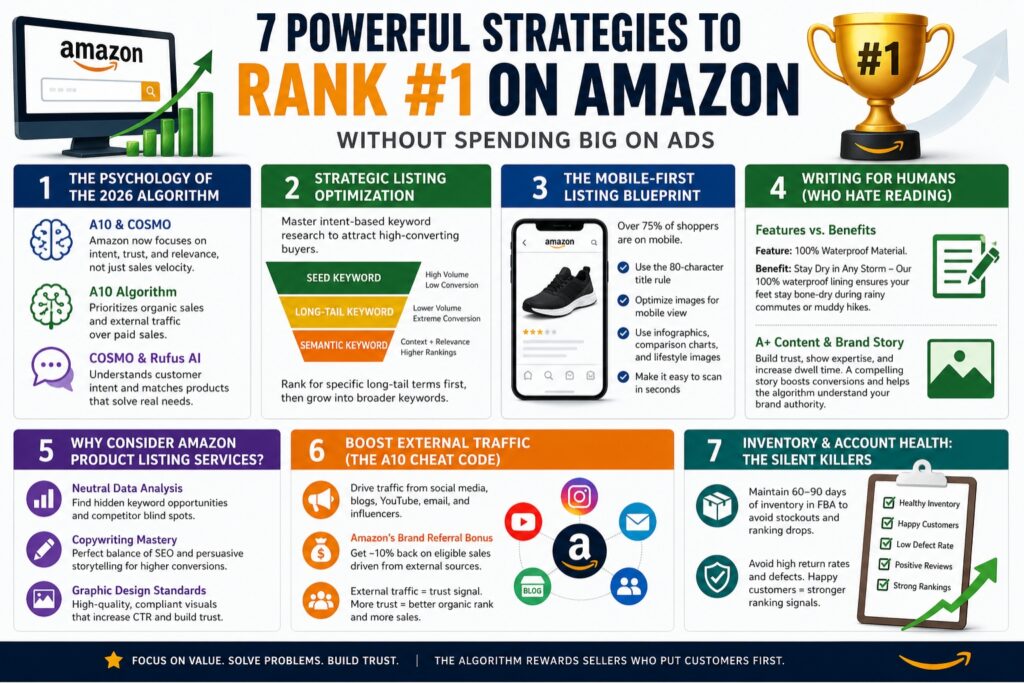
Amazon’s algorithm has shifted from a “sales velocity” focus to an “intent” focus. It doesn’t just look at how much you sell; it looks at how people find you.
- A10 Algorithm: Prioritizes organic sales and external traffic over paid sales. If your sales come only from ads, Amazon won’t “trust” your organic rank.
- COSMO & Rufus AI: These AI layers try to understand why a customer wants a product. For example, if someone asks Rufus, “Which shoes are best for a beach wedding?”, the AI looks for listings that mention “sand-resistant,” “breathable,” and “formal outdoor style”—not just the keyword “shoes.”
2. Strategic Amazon Product Listing Optimization
Effective optimization is the foundation of organic growth. It’s the “engine” of your listing. If the engine isn’t tuned, no amount of fuel (ads) will make it win the race.
Master “Intent-Based” Keyword Research
Stop chasing only high-volume keywords. If you sell “ergonomic office chairs,” trying to rank for just “chair” is a waste of money.
- The Seed: “Office chair” (High volume, low conversion).
- The Long-Tail: “Ergonomic office chair for lower back pain” (Lower volume, extreme conversion).
- The Semantic: “Breathable mesh desk chair for 8-hour shifts.”
The Strategy: The Strategy: Rank for the specific long-tail terms first. When you convert 20% of people searching for a niche term, Amazon realizes you’re a high-quality product and starts “testing” you on the bigger, broader terms. For example, a seller offering a rectangle trampoline may achieve better results by targeting specific buyer-intent searches instead of relying only on broad keywords like “trampoline.”
3. The “Mobile-First” Listing Blueprint
Over 75% of Amazon shoppers are now on mobile. If your listing looks like a wall of text, you’ve already lost.
The 80-Character Rule
On mobile, Amazon cuts off your title after about 80 characters.
- Bad Title: Brand Name Super Amazing Ultra Comfortable Red Running Shoes for Men and Women Size 10…
- Winner Title: [Brand] Men’s Lightweight Running Shoes – Breathable Mesh for Long Distance…
Visual SEO (The “Scan” Test)
Shoppers look at images before they read a single word.
- The Hero Image: Must be 2000×2000 pixels. It needs to fill 85% of the frame.
- The “Problem/Solution” Infographic: Image #2 should show the biggest pain point the customer has and how you fix it.
- The Comparison Chart: Don’t let them leave your page to compare. Show them why you’re better than “the other guys” right there.
4. Writing for Humans (Who Hate Reading)
Amazon’s A10 algorithm now monitors “Dwell Time”—how long a customer stays on your page. If they bounce in 2 seconds, your rank drops.
Bullet Points: Features vs. Benefits
Don’t just list facts. Connect them to a feeling or a result.
- Feature: “100% Waterproof Material.”
- Benefit (The Human Way): “Stay Dry in Any Storm – Our 100% waterproof lining ensures your feet stay bone-dry during rainy commutes or muddy hikes.”
A+ Content & Brand Story
If you are Brand Registered, A+ content is non-negotiable. Use the Brand Story module. Rufus (Amazon’s AI) reads these modules to understand your brand authority. A compelling story builds trust, and trust drives the conversion rate that feeds the algorithm.
5. Why Consider Amazon Product Listing Services?
Many sellers reach a plateau because they are too close to their own product. Professional Amazon product listing services provide:
- Neutral Data Analysis: They find keywords you didn’t know existed by analyzing competitor “blind spots.”
- Copywriting Mastery: They know how to balance “keyword density” for the algorithm with “persuasive storytelling” for the human buyer.
- Graphic Design Standards: Professionals ensure your images meet the strict 2026 Amazon compliance rules while maximizing “Click-Through Rate” (CTR).
6. Boosting “External Traffic” (The A10 Cheat Code)
This is the single fastest way to rank without ads. Amazon loves it when you bring new customers to their platform.
- The Referral Bonus: Amazon’s Brand Referral Bonus program actually gives you back ~10% of the sale price when you drive traffic from social media or your email list.
- Social Proof: A single mention in a niche blog or a short-form video sends a “trust signal” to Amazon that your product is trending. Amazon rewards this by bumping your organic rank higher than sellers spending thousands on PPC.
7. Inventory & Account Health: The Silent Killers
You can have the perfect listing, but if you go out of stock, your rank will crater.
- The 60-Day Rule: Aim to keep 60–90 days of inventory in FBA.
- The “Defect” Trap: High return rates or negative reviews tell the algorithm your product is a “bad recommendation.” Prioritize customer service and “Product Q&A” to resolve doubts before they turn into bad reviews.
Summary Checklist for Ranking #1
| Task | Strategy |
| Keywords | Focus on “Buyer Intent” long-tail phrases. |
| Title | Front-load the main keyword in the first 80 characters. |
| Images | Use “Visual SEO” to explain the product in 5 seconds. |
| Bullets | Outcome first, Feature second. |
| Backend | Fill every single attribute (COSMO loves structured data). |
| Traffic | Drive 10-15% of your traffic from outside Amazon. |
Final Thought
Ranking #1 without ads is a marathon, not a sprint. It’s about building a “Conversion Machine.” When your listing converts better than your competitors, Amazon’s algorithm has no choice but to put you at the top—because every time they show your product, they make money.
Focus on the customer, and the rank will follow.
TAGS
