

A good portrait can leave a lasting impression on you as a viewer. The level of detail in your face is important when evaluating the quality of a photograph. Portraits may fall short of ideal photographic conditions due to poor lighting or camera limitations, low resolution, or motion blur; thus, images can lack sufficient face detail.
AI face enhancers use advanced AI to improve or create a high-quality image by analyzing and improving portraits. Unlike traditional methods of editing photographs, which require many hours of manual work, AI technology analyzes facial features and then automatically restores clarity and improves the quality of an image in seconds.
Increasingly popular among professional photographers, businesses, and non-professionals, AI technology has radically altered the way users use image enhancement. Users can now enhance their portrait photographs without having extensive experience or having to purchase expensive software.
Why Portrait Quality Matters More Than Ever
In a digital-first world, visual content often serves as the first interaction people have with a brand or individual. High-quality portraits can create a positive impression, while blurry or low-quality images may negatively affect credibility.
For professionals, a polished portrait can strengthen personal branding efforts. For businesses, clear team photos and marketing visuals contribute to a more trustworthy image. Even personal photographs benefit from enhanced clarity, helping preserve memories with greater detail.
Common Problems Found in Portrait Images
Many portrait photographs suffer from issues that reduce their overall impact. These problems can occur even when using modern cameras and smartphones.
- Blurry facial details caused by movement
- Low-resolution images with limited clarity
- Noise and grain from poor lighting conditions
An AI face enhancer is specifically designed to identify and correct these issues while maintaining the natural appearance of the subject.
What Is an AI Face Enhancer?
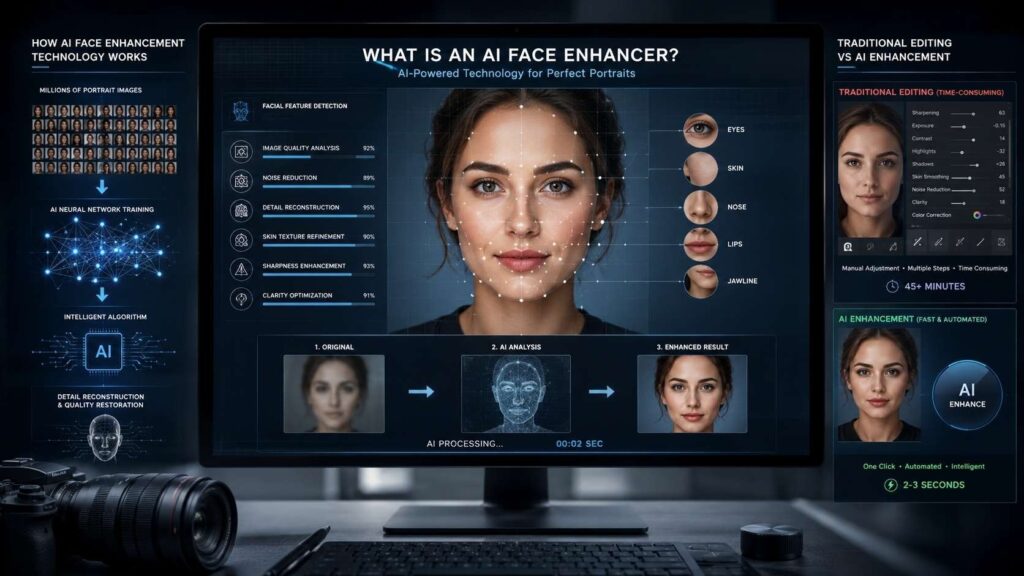
An AI face enhancer is a type of image enhancement product that utilizes machine learning to enhance facial details in photographs. Unlike a traditional filter that applies generic adjustments to the whole photo, AI enhancement applies targeted facial region enhancement. The technology first identifies major landmark points on the face (the eyes, nose, lips, jawline, and skin texture). Once the landmark points have been identified, the AI will analyze the image and then apply targeted enhancements to those areas based on the evaluation of the quality of the image.
This intelligent design allows the software to sharpen facial details, improve texture, reduce noise, and provide clarity without making the portrait appear overly processed.
How AI Face Enhancement Technology Works
Modern AI systems are trained using millions of portrait images. Through this training process, they learn how facial features should naturally appear and how to restore details that may be missing due to image quality limitations.
When a photo is uploaded, the AI performs several actions simultaneously. It identifies facial structures, evaluates image quality, reconstructs lost details, and applies enhancement techniques designed to improve realism.
The entire process often takes only a few seconds, making AI enhancement significantly faster than traditional retouching methods.
The Difference Between Traditional Editing and AI Enhancement
Traditional editing software typically requires manual adjustments for sharpening, skin correction, noise reduction, and facial retouching. While this approach offers complete control, it can be time-consuming.
AI enhancement automates many of these tasks. Instead of manually editing every detail, users can achieve professional-looking improvements through intelligent automation. This makes AI technology particularly useful for processing large collections of images efficiently.
AI Skin Texture Enhancer for Natural-Looking Results
The AI skin texture enhancer is an amazing step forward in portrait editing. Traditionally, skin retouching has been difficult because when you manually smooth out a person’s face, it often smoothes out too much of the detail and made it look like a mannequin’s face. By contrast, today’s AI skin texture enhancers balance the amount of texture they remove versus the amount of freshness and realism they maintain because of the natural texture of our skin. Therefore, it allows us to create a polished finish on our portraits but retain real looking features and characteristics.
Why Skin Texture Matters in Portrait Photography
Texture and porosity (i.e., pores) of the human skin create subtle variations (i.e., imperfections) that add realism and authenticity to the subject being photographed; when the skin is overly smooth, portraits can become surrealistic and lose their appeal due to the way in which the subject’s facial features have been altered.
AI skin texture enhancement works to decrease distractions (e.g., blemishes, uneven tones) while ensuring that all of the necessary details that are required for creating a real image of human skin remain; therefore, the result will be much more professional-looking than otherwise possible.
Benefits of AI Skin Enhancement
AI-powered skin enhancement provides several advantages for photographers and businesses.
- Preserves natural skin texture
- Reduces editing time significantly
- Creates consistent results across multiple images
Because the process is automated, users can enhance large numbers of portraits without sacrificing quality or realism.
Improve Face AI Technology for Better Portraits
As images play an increasingly important role across all industries, the need for better facial AI continues to increase. High-quality pictures of faces are vital for communicating in an effective way to users of businesses and other people, such as photographers, influencers, and social media content producers.
The flexibility and efficiency of AI tools allow individuals to enhance the quality of their portraits while maintaining the same visual impact. Using these AI tools provides a valuable resource for people who work with large numbers of pictures.
How Businesses Use AI Face Enhancement
Professional portraits are commonly used in corporate websites, marketing materials, employee directories, and social media campaigns. Clear and polished images help businesses establish trust and professionalism.
AI enhancement enables organizations to improve portrait quality quickly without requiring extensive manual editing resources.
Benefits for Content Creators and Influencers
Social media platforms are highly visual environments where image quality can influence engagement. Content creators often use AI enhancement tools to improve portrait clarity and create a stronger online presence.
Enhanced facial details help images stand out while maintaining a natural appearance that resonates with audiences.
Industries Benefiting from AI Face Enhancement
The applications of AI face enhancement extend far beyond personal photography. Multiple industries now incorporate this technology into their workflows to improve image quality and efficiency.
Professional Photography
Portrait photographers use AI enhancement to refine images before delivering them to clients. The technology helps restore details, improve clarity, and streamline post-production processes.
E-Commerce and Marketing
Businesses frequently use portraits in advertisements, product promotions, and brand campaigns. Enhanced images contribute to a more polished and professional presentation.
Real Estate and Corporate Branding
Agents, consultants, executives, and corporate teams often rely on professional headshots. AI enhancement helps ensure these images reflect professionalism and confidence.
Social Media and Personal Branding
Whether building a personal brand or growing an online audience, high-quality portraits can significantly improve visual impact and audience engagement.
How to Get the Best Results with an AI Face Enhancer
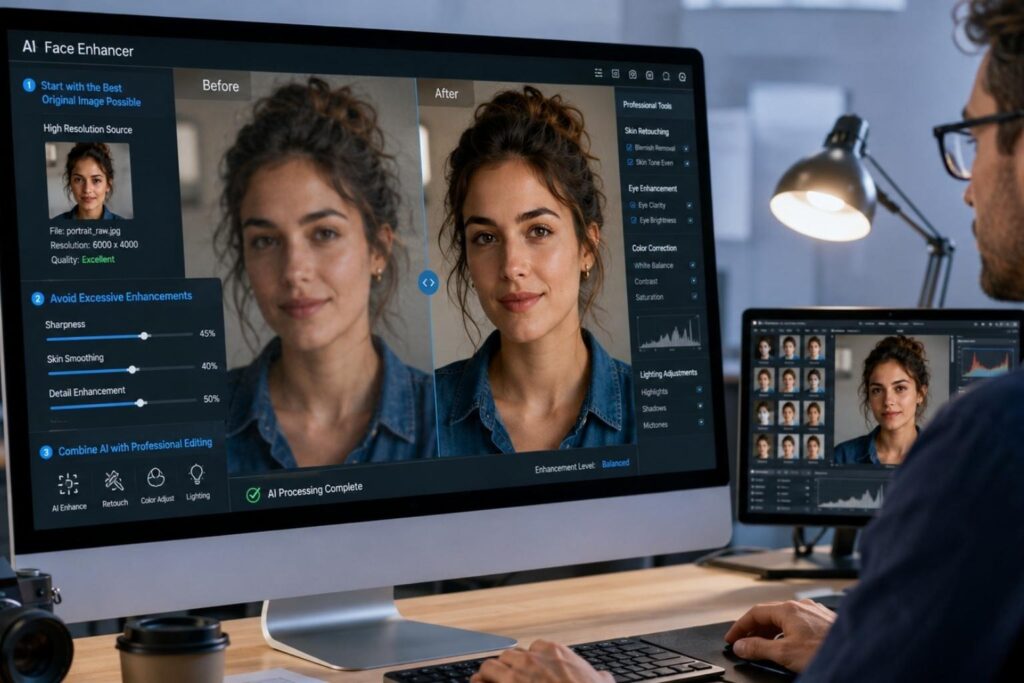
While AI technology is powerful, following a few best practices can help maximize results.
Start with the Best Original Image Possible
Although AI can improve image quality, higher-quality source images generally produce better outcomes. Whenever possible, use the highest-resolution version of a photograph.
Avoid Excessive Enhancements
Over-processing can make portraits appear unrealistic. Natural-looking improvements often produce the most professional results.
Combine AI with Professional Editing
AI enhancement works exceptionally well when combined with expert retouching techniques. Human editors can make creative adjustments that complement automated improvements.
For additional insights into portrait enhancement, facial retouching, and image editing workflows, visit:
This guide provides valuable information that can help users better understand professional face editing techniques and how they work alongside modern AI technologies.
The Future of AI Face Enhancement
Rapid growth is happening with artificial intelligence, and advancement of face enhancement technologies is expected to continue at a faster pace than ever. Future advancements may include improved accuracy of facial reconstruction, better preservation of skin texture, or enhanced capabilities for editing bodies in real-time.
These innovations will become increasingly common in photography, marketing, content creation, and digital communications as AI-based face enhancement continues to develop.
Conclusion
AI portrait enhancement is a revolutionary way to correct your pictures to be high-quality portraits that don’t lose their authenticity in the process of being edited. Via enhancements such as facial detail restoration and feature sharpening, along with an AI skin texture enhancers to provide a more realistic skin improvement, the new technologies associated with AI have dramatically changed how we edit portraits.
This includes the ability to enhance professional head shots or restore an old family photo, as well as create eye-catching social media content through enhancing imagery. As new technology can be used to continue improving “face AI”, the sophistication of the image quality will continue to improve, providing new avenues for creating beautiful images while maintaining the authentic quality of the original images.
TAGS
